Showing posts with label Vintage. Show all posts

Saturday, June 1, 2013

Yashica-24

Quite rare, quite good. 

... (plus, a short introduction to Yashica)


© tedguuphoto 2013 all rights reserved

Before the 1960s, Japanese camera manufactures are producing much the same things; imitating the Leica's, Rollei's and other German camera brands. But by the year 1960, Japanese brands became more and more independent. So today, we will be taking a look at one of the most unique brands, proclaimed to be Japan's finest camera manufacturer - Yashica.

Yashica started it's TLR-making tradition since it was established in the early 50s. Back then, it's TLRs was still a Pigeon, literally a Pigeon...flex. It was a basic design comprising of a three elemental glass lens and a simple shutter mechanism found in the later Yashimaflex.

In 1965, Yashica introduced the 24, which in the later years became the basis for the 12, the 124, and the 124G. As the name suggests, the 24 is made to cater only 220 film which is hardly available fresh today. Yashica's advertisements and user manuals also doesn't seem to indicate whether 120 film can be used with the 24 or not, but many owners including me can get around this problem and here's a mini step-by-step guide on how to do so:
.
  1. Open the back door as usual by turning the knob to the 'O' direction.
  2. After you've lifted the back door you'll find the film chamber in which the left over spool from the last roll of film will reside just under the taking lens.
  3. Take the empty spool off by pulling the exterior knob next to where the spool is and gently lift it out. After doing so, place the empty spool into the top part of the chamber.
  4. Insert the 120 film and lead it across the to the empty spool. Make sure the both the film and the paper backing slides between the two silvery metal bumps, not over it.
  5. After you're done loading, 'Go out and take some photos'
  6. Just don't forget that the film counter will go on and on until it reaches 24 exposures, so make sure to stop at 12 so that you won't waste your time shooting nothing.
Thursday, May 30, 2013

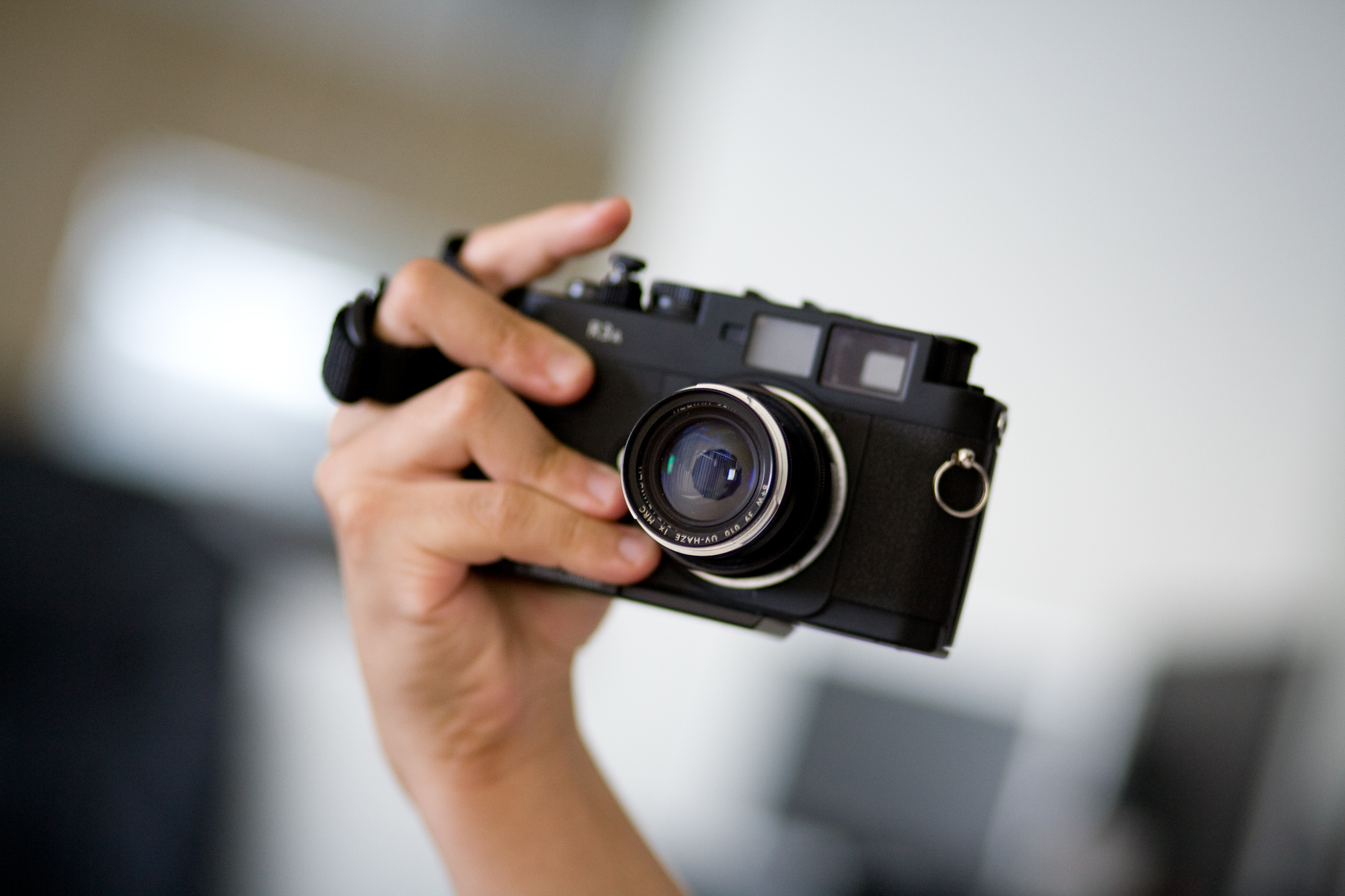
Voigtländer Bessa R2A & R3A

Like Leica, but without the price.


CC Image courtesy of Shane Lin on Flickr

Leica had always been the pinnacle of rangefinder photography. The privilege to own one is simply a dream come true, but what about our friend Voigtländer? Is it still in the game for Leica aficionados like you and me to appreciate it's value and beauty? Well, let's find out in the new review of the Voigtländer R2A/R3A.

The Bessa R2A introduced in 2004 at Photokina alongside the R3A is basically a revamp of the R2 with the advantage of aperture priority and the ability to mount Leica glass. Both cameras are pretty identical including it's functionality and design with exception of the framelines; the R2A with 0.7x magnification, and the R3A with a 1:1 'to scale' finder - one of the first Leica M mount cameras to possess this feature. The R3A's finder, compared to other 1:1 RFs is extremely bright with easy-to-see framelines, which is quite surprising due to most 1:1 models possessing a much dimmer finder with difficult to read framelines.

Both the R2A and the R3A are battery based; meaning that without the battery, the camera's electronic shutter won't work, therefore rendering the camera practically useless. The battery used in the R2A and R3A is the 1.5V alkaline battery used in most AE rangefinder cameras. 

Although the Bessas' are designed to be Leica M mountable and performs incredibly well with it, some lenses are not recommended to be used with the R bodies especially those with a deeply recessed rear lens element or a collapsible barrel. This is due to the shutter curtain that is recessed not so deeply into the camera body. Though there is a metal stopper between the lens and the shutter curtain, it is still probably not a good idea to slam in the lens as you might damage your precious glass and camera. The good thing is, if you careful enough then it would probably be fine.
.

Monday, May 20, 2013

Canonet G-III QL17

A cult camera. An icon of the 70s'


CC Image courtesy of Lozit on Wikimedia Commons

In recent years, the Canonet G-III QL17 had proven to be a hit amongst hipsters and Canon fanboys alike, but back in the days, the G-III was one of the bestsellers of Canon since Canon was around! First off, for those who are new to the camera, the Canonet is the series of 35mm compact RF's, the G-III is the third generation of the Canonet series, QL is what Canon regarded as the 'Quick-Load' system which semi-automatically loads the film into the camera, and 17 is it's widest aperture at f/1.7. 

Throughout the years, Canon had been pumping tons of Canonet's ranging from the QL17, which is the series' top-dog camera, to the QL19 and the 28. Today, I will be talking about what we consider as the best compact 35mm Rangefinder of all time; the G-III QL17.

Canon made it's first debut of the G-III back in 1972 with a staggering 1.2 million sales through to 1982, making the G-III probably one of the most successful camera in it's time. The specifications on this camera even surpasses the Leica CL albeit in a much cheaper price; just imagine a Sony RX1 with a 1.7 lens for 200 bucks? Incredible.

The Canonet G-III QL17 as said before is a compact 35mm rangefinder which boasts some amazing specs including a fast 40mm 1.7 lens, which is wide enough for some landscape shots, and long enough to do some portrait work on the streets with the closest focusing distance of 0.8 meters or 2.6 feet. To top that off, the lens is combined with automatic exposure and manual over-ride, a killer feature back in those days.

The rangefinder on the G-III is surprisingly bright but has a slight blue tint to it; a typical feature in early compact rangefinders to improve contrast, but I suppose it would not make much difference if you shoot black and white. The finder sports a 0.6x magnification, which goes extremely well with the 40mm lens and a frameline that compensates parallax error, which is very rare amongst cameras of the same genre.

Wednesday, May 1, 2013

Mamiya 6

What could be better than this?


CC Image courtesy of entropiK on Flickr

When one simply talks about rangefinders, Leica would be the first thing to pop up into mind. But photographers and film enthusiasts alike will instantaneously recognize the fame and glory of the Mamiya 6 and it's ever growing popularity amongst lovers of medium format and rangefinder photography.

For those who don't know, the 'New' Mamiya 6 is not an update or a new version of the old folding Mamiya Six camera. In fact, the Mamiya Six is a very different camera altogether; with a fixed lens and mechanical inner workings, a technology reminisce of the early 40s.

Introduced in 1989, the Mamiya 6 came out with three lenses; the 50mm, 75mm and 150mm. All three lenses for this system are incredibly sharp from corner to corner, producing images similar, or even better than the Zeiss lenses on Hasselblad V bodies.

So what is special about the Mamiya 6? Well, as a travel and street photographer, traveling light is key. No matter what destination it may be, lugging huge medium format SLRs with a set of lenses and backs is not ideal, and so the Mamiya 6 comes into play. The rangefinder design of Mamiya 6 is incredibly compact for it's category, and with the ability to collapse it's lenses, the size of the whole system can be as small, or perhaps even smaller than today's DSLRs. 

The another advantage of the Mamiya 6 over many other cameras of the same league is the image quality. This is driven solely by the lenses, which like Leica, can surpass the quality of SLR lenses because of the fact that the rear lens element can sit closely to the film giving extremely sharp results. This makes the Mamiya 6 one of the best cameras out there you could possibly buy.

Tuesday, March 12, 2013

Canonflex

Canon's first SLR. And the world's best looking...


Canonflex 'Flex' CC Image courtesy of Joshua Blais on Flickr

Back in 1959, Canon introduced it's first lineup of SLR s to the market, the Canonflex, with just a mere production of 17,000 cameras. Though the Canonflexes are not quite as popular as the Nikon F's, collectors nowadays starts to appreciate the amount construction and engineering that has been put into this beast of a camera.

During the 50's, SLR s were new and not so much a hit, as rangefinders are dominating most of the camera market. But before the realization of the masses about how easy and intuitive SLR s are, people were used to the old rudimentary technique of focusing through a separate viewfinder, trying to overlap two images to focus.

The first thing you'll notice once you've picked up the Canonflex is that it it built like a tank. Solid as a rock, and well made. The construction, I have to say, is quite phenomenal compared to what is on offer today. 

The second thing after the build, you'll notice that the film advance level is situated at the bottom of the camera with a 130 degrees throw. Some say it is more intuitive to use, but after using it on the field for quite some time, it will become apparent that using this camera on a tripod is as challenge as it is handheld.

Sunday, March 3, 2013

Leica M6 & M6 TTL

Best Leica M for film photography?


CC Image courtesy of mr.Wood on Flickr

Launched in 1984, the M6 marked the return of the production from Leica's Canadian base back to Wetlzar, Germany, and soon to Sölms.

The M6 is considered by many as the best Leica M, and even the best 35mm film camera you could get out there. Many photographic enthusiasts who wanted to get into the world of Leica can simply pick one of these workhorses off from eBay at a relatively affordable price, and if your lucky enough,  you can own one with a lens at just above $1000.


Although some might argue that the M3, and the all mechanical MP are far superior than the M6, I would say that these are different cameras all round, serving different purposes and offers different results according to different tastes. The MP and the M3 are all mechanical, requiring just you and your brain to take that shot, a cult camera for the ones who solely believe in minimalism and appreciate the pureness of German engineering. The M6 and the M6 TTL on the other hand, are much more modern, offering (through-the-lens) TTL metering with red LED " < > " arrows to assist you in any given situation.