Sunday, June 9, 2013

Bangkok Lights

Bangkok - The world capital for street photography


© tedguuphoto 2013 all rights reserved - *All photos taken with my trusty Canon 60D

Bangkok had long been famous for it's lively streets, bustling with people and yes, lots of traffic. Here, lots of things are happening as the clock is ticking away to the end of the day. That's precisely the recipe for a good street photography shoot. But as I was planning for a trip around BKK the day after, I've suddenly gotten an idea, to break my comfort zones and start shooting early, way early than what I've used to. I started my day at 5 in the morning around the famed 'Flower market' area to seek for some life. Surprisingly, people had already been working their socks off, selling flowers on the dimly lit streets like madness. People with trolleys seemingly filled the streets more so than the cars during the day, pushing and shoving each other. It was an utter chaos. Still, I've managed to get some good photos out of it, and yes, it all ended up well. So, to illustrate what I had experienced, here are some photos I'd took during the early times of Bangkok City.

(Click to see full-sized images)
.

Thursday, June 6, 2013

Paris Pt. II

© tedguuphoto 2013 all rights reserved

Paris is one of those cities that never changes. The charm and the pure essence of French culture had pretty much been the same for centuries and this is precisely what makes Paris, Paris. Amidst the ever-growing world, where countries and their economies are rapidly advancing into the race to become the best, the greatest and the most powerful, people come to forget their past and how the past makes up into what we are today. Now some people do realize the importance of this matter and are yearning to escape from it; escaping from the modernization that relentlessly overshadows the past.

Many cities now fall into the trap of constructing the biggest, the tallest, the most architecturally advanced skyscrapers, but Paris had kept itself in a very humble position. When looking around the city, the tallest structure bearing the very symbol of Paris is the Eiffel Tower. It is very amazing to see such city where it's people can live together in harmony with art and history, instead of attaching one's self to the materialistic structures we see today in most other cities. It is without doubt that Paris holds a special allure that draws millions of visitors a day, to be one of the many eyewitnesses to one of the world's greatest city.

Paris itself is already the world capital of architecture, and the Palace of Versailles is a good example of that. This monumental centerpiece is one of the world's largest Palace that holds many important moments in French history. The most relevant and well-known to us would be the Treaty of Versailles that took place in the Hall of Mirrors. It is quite hard to imagine myself standing right at that position where the peace treaty took place, it is simply astonishing to be part of history itself.

Strolling along the Gardens of Versailles is also an amazing experience. The sculptures and the geometrically trimmed vegetations are one strong example that France had been a great empire, and a wealthy one too.

Back at the Louvre for another day (for free) had also been a great experience. I have never had enough of the Louvre. There is simply too much for me to see in one day. Stood majestically in front was the Louvre Pyramid. The modern architecture of glass and steel seemingly juxtapose or rather blends in with the classical elements of the existing Musée de Louvre. Although the second round was free, it paid off with masses of tourists who again, flock to witness the Mona Lisa without even recognizing other masterpieces that hang on the walls of the Museum.

After a trip along the River Seine, it was home time. Although I was back in the UK, I must confess that my heart was and is staying in Paris and I hope that will never change, because for me, four days is simply too short for such a city like Paris.

(Click to view full-sized images)

Tuesday, June 4, 2013

News update #2

UPDATE


Paris Pt. II is on it's way very shortly! Plus - the first to one of the three parts special of the new 'Street Photography' series is pumping out pretty soon! So stay tuned because it's free to read! 

Also, don't forget to come and like my Facebook page, it's growing everyday! Thanks in advance to you readers of the interweb for your kind support! 

- Oh! And don't forget to 'Go out and take some photos™!'

Saturday, June 1, 2013

Yashica-24

Quite rare, quite good. 

... (plus, a short introduction to Yashica)


© tedguuphoto 2013 all rights reserved

Before the 1960s, Japanese camera manufactures are producing much the same things; imitating the Leica's, Rollei's and other German camera brands. But by the year 1960, Japanese brands became more and more independent. So today, we will be taking a look at one of the most unique brands, proclaimed to be Japan's finest camera manufacturer - Yashica.

Yashica started it's TLR-making tradition since it was established in the early 50s. Back then, it's TLRs was still a Pigeon, literally a Pigeon...flex. It was a basic design comprising of a three elemental glass lens and a simple shutter mechanism found in the later Yashimaflex.

In 1965, Yashica introduced the 24, which in the later years became the basis for the 12, the 124, and the 124G. As the name suggests, the 24 is made to cater only 220 film which is hardly available fresh today. Yashica's advertisements and user manuals also doesn't seem to indicate whether 120 film can be used with the 24 or not, but many owners including me can get around this problem and here's a mini step-by-step guide on how to do so:
.
  1. Open the back door as usual by turning the knob to the 'O' direction.
  2. After you've lifted the back door you'll find the film chamber in which the left over spool from the last roll of film will reside just under the taking lens.
  3. Take the empty spool off by pulling the exterior knob next to where the spool is and gently lift it out. After doing so, place the empty spool into the top part of the chamber.
  4. Insert the 120 film and lead it across the to the empty spool. Make sure the both the film and the paper backing slides between the two silvery metal bumps, not over it.
  5. After you're done loading, 'Go out and take some photos™'
  6. Just don't forget that the film counter will go on and on until it reaches 24 exposures, so make sure to stop at 12 so that you won't waste your time shooting nothing.

Thursday, May 30, 2013

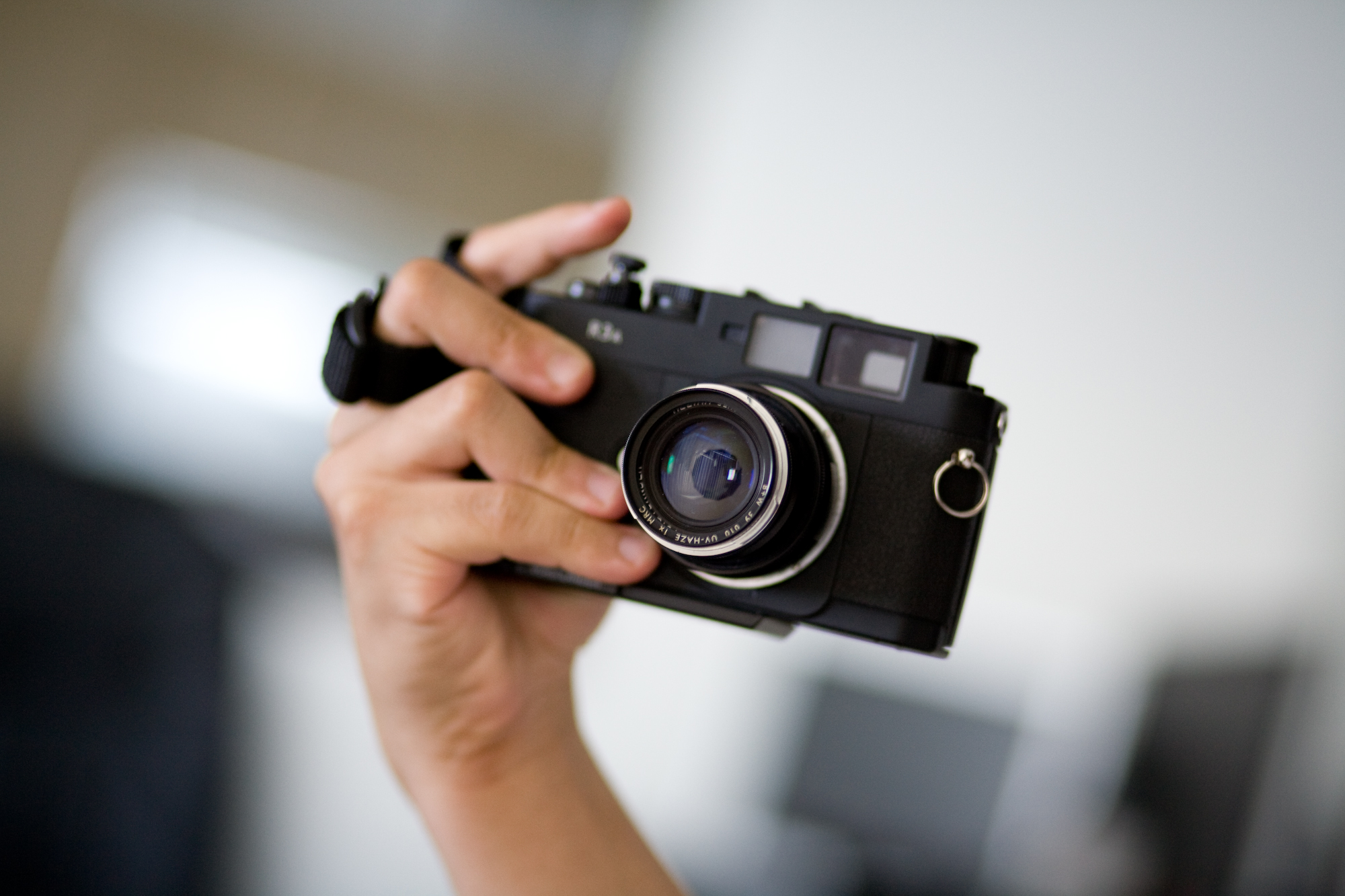
Voigtländer Bessa R2A & R3A

Like Leica, but without the price.


CC Image courtesy of Shane Lin on Flickr

Leica had always been the pinnacle of rangefinder photography. The privilege to own one is simply a dream come true, but what about our friend Voigtländer? Is it still in the game for Leica aficionados like you and me to appreciate it's value and beauty? Well, let's find out in the new review of the Voigtländer R2A/R3A.

The Bessa R2A introduced in 2004 at Photokina alongside the R3A is basically a revamp of the R2 with the advantage of aperture priority and the ability to mount Leica glass. Both cameras are pretty identical including it's functionality and design with exception of the framelines; the R2A with 0.7x magnification, and the R3A with a 1:1 'to scale' finder - one of the first Leica M mount cameras to possess this feature. The R3A's finder, compared to other 1:1 RFs is extremely bright with easy-to-see framelines, which is quite surprising due to most 1:1 models possessing a much dimmer finder with difficult to read framelines.

Both the R2A and the R3A are battery based; meaning that without the battery, the camera's electronic shutter won't work, therefore rendering the camera practically useless. The battery used in the R2A and R3A is the 1.5V alkaline battery used in most AE rangefinder cameras. 

Although the Bessas' are designed to be Leica M mountable and performs incredibly well with it, some lenses are not recommended to be used with the R bodies especially those with a deeply recessed rear lens element or a collapsible barrel. This is due to the shutter curtain that is recessed not so deeply into the camera body. Though there is a metal stopper between the lens and the shutter curtain, it is still probably not a good idea to slam in the lens as you might damage your precious glass and camera. The good thing is, if you careful enough then it would probably be fine.
.

Monday, May 27, 2013

Paris Pt. I

© tedguuphoto 2013 all rights reserved

Paris, a city enriched in culture and history is one of Europe's most romantic and enchanting destinations. It is without doubt that more than 30 million tourists a year flock into this city to admire it's beauty through architecture, people and of course French food!

The journey to Paris is an absolute pleasure. My first impressions of the city had already been quite positive since I've first arrived at the 'Gare du Nord' station. The architecture is absolutely phenomenal. But above all it was the Louvre. The museum is one of the 'must-see' sights in Paris with so many things to do, but many tourists seem to come all the way here only to see the Mona Lisa. I was extremely shocked to see such thing, I'm not saying that it is wrong to do so, but there's just so many other artifacts and masterpieces to admire, even the building itself is thing worthy of appreciation.

The Eiffel tower was my next destination. It is without doubt the most crowded place in all of France, but I should say the view is absolutely breathtaking, and definitely worth the wait. There's too much to say about the Eiffel Tower, so I will leave it there for you guys to enjoy the photographs for yourself.

This first series of photographs from Paris is some of the best shots taken during the trip and I hope these series of photos would stimulate the 'traveller' inside you and convince you to take a trip of your life to one of the world's most beautiful city, Paris.

(Click to view full-sized images)

Tuesday, May 21, 2013

News update #1

UPDATE


In the next few days, I will be releasing the premiere of 'PARIS' part 1 - Part 2 is still a work in progress... 'United Kingdom' is coming soon!

With the delay of 'PARIS', I will be constantly updating the blog with news and reviews of analog cameras and maybe a tip or two about street photography!

- Our facebook page is now online! Please like to support me and my work!

Monday, May 20, 2013

Canonet G-III QL17

A cult camera. An icon of the 70s'


CC Image courtesy of Lozit on Wikimedia Commons

In recent years, the Canonet G-III QL17 had proven to be a hit amongst hipsters and Canon fanboys alike, but back in the days, the G-III was one of the bestsellers of Canon since Canon was around! First off, for those who are new to the camera, the Canonet is the series of 35mm compact RF's, the G-III is the third generation of the Canonet series, QL is what Canon regarded as the 'Quick-Load' system which semi-automatically loads the film into the camera, and 17 is it's widest aperture at f/1.7. 

Throughout the years, Canon had been pumping tons of Canonet's ranging from the QL17, which is the series' top-dog camera, to the QL19 and the 28. Today, I will be talking about what we consider as the best compact 35mm Rangefinder of all time; the G-III QL17.

Canon made it's first debut of the G-III back in 1972 with a staggering 1.2 million sales through to 1982, making the G-III probably one of the most successful camera in it's time. The specifications on this camera even surpasses the Leica CL albeit in a much cheaper price; just imagine a Sony RX1 with a 1.7 lens for 200 bucks? Incredible.

The Canonet G-III QL17 as said before is a compact 35mm rangefinder which boasts some amazing specs including a fast 40mm 1.7 lens, which is wide enough for some landscape shots, and long enough to do some portrait work on the streets with the closest focusing distance of 0.8 meters or 2.6 feet. To top that off, the lens is combined with automatic exposure and manual over-ride, a killer feature back in those days.

The rangefinder on the G-III is surprisingly bright but has a slight blue tint to it; a typical feature in early compact rangefinders to improve contrast, but I suppose it would not make much difference if you shoot black and white. The finder sports a 0.6x magnification, which goes extremely well with the 40mm lens and a frameline that compensates parallax error, which is very rare amongst cameras of the same genre.